• Skip to main content
  • Skip to primary sidebar
  • Skip to footer

Devine Concepts

Mobile Electronics Expert in Naples, Florida

  • Home
  • Services
    • Car Audio
    • Custom Installation
    • Driver Safety
    • Radar / Laser Detectors
  • About Us
    • Awards and Accolades
    • Meet the Team
    • Virtual Tour
  • Location
  • Contact Us
  • Facebook
  • Instagram
  • YouTube
  • Search

Car Audio

Revisiting The Rockford Fosgate T500-1bdCP Review

BestCarAudio.com - September 2, 2024

T500-1bdCP Review

In January of 2024, we had the privilege of reviewing the Rockford Fosgate T500-1bdCP amplifier. Based on our experiences with amplifiers from the company, it was no surprise that the amp sounded amazing, was impressively efficient, and exceeded all of its power ratings. The latter is the focus of the re-test. We’ve recently upgraded the power supplies in the BestCarAudio.com Test Drive Review lab. As such, we can supply the subjects with a full 14.4 volts to provide you with measurement numbers that comply with the ANSI/CTA-2006-D standard. So, let’s have another quick look at the highlights of this impressive amplifier, then dig into some new power measurements and efficiency calculations.

Rockford Fosgate T500-1bdCP Features

Here’s what you need to know without going into the same detail as the original Rockford Fosgate T500-1bdCP Review. Firstly, this is a dedicated subwoofer amplifier. It has an as-measured -3dB frequency response of 4.4 to 230 hertz. That bottom-end extension is pretty impressive.

The amp is rated to produce 300 watts of power when connected to a four-ohm load and 500 watts to two- and one-ohm loads. There are amplifiers that produce more power for less money. However, this amp also sounds fantastic. We measured an impressive 0.0213% THD+N at four ohms. Like many others, the amp didn’t fall on its face at lower impedances. Distortion numbers dropped to 0.0226% at two ohms and a still impressive 0.0294% when driving a one-ohm load. These measurements were taken at the ANSI/CTA-2006-D standard of 1-watt output. However, the graph you’ll see below shows the amp remains composed across the entire power output range.

Feature-wise, the amp includes an adjustable -24dB/octave low-pass filter that can be set anywhere between 35 and 250 hertz. It also has a selectable infrasonic filter fixed at 28 hertz with a -12dB/octave second-order slope. Lastly, and as you’d expect, the amp includes the Punch EQ control. Your installer can use this to dial in up to 18dB of boost at 45 hertz to add some extra slam to your audio system. The Punch EQ filter is nice and narrow, so turning it up doesn’t make your midbass sound terrible.

T500-1bdCP Review
All the connections are made along the front edge of the amplifier to keep installations tidy.

An essential feature of the amplifier that many overlook is its cast-aluminum heatsink. Unlike extruded designs, cast heatsinks offer significantly more surface area. When combined with expertly designed efficient circuitry, your amplifier will play longer without overheating. We tested the T500-1bdCP for over an hour at full power into a two-ohm load, and it never shut down. By comparison, we’ve had several amps go into thermal protection in under four minutes. Cast heatsinks are significantly more expensive to manufacture, but if you want to know why people are still using three-decade-old Rockford Fosgate gear, this is one of the reasons why. Think of it like comparing a Zippo lighter to a plastic BIC lighter. Both might light the candles on a cake, but only one is designed to last for your entire life.

T500-1bdCP Review
A Rockford Fosgate T500-1bd and T600-4 installed in the front boot of a Ferrari 430.

Re-Testing the T500-1bdCP

The ANSI/CTA-2006-D Testing and Measurement Methods for In-Vehicle Audio Amplifiers standard has changed a bit from previous versions. Specifically related to continuous power testing, the sensitivity control should now be set to its minimum sensitivity setting. Looking at it from the opposite perspective, the amp should be set to make its maximum power from the highest amount of input signal. For the T500-1bdCP, that would be five volts, according to the owner’s manual. We’ll discuss why this matters in another article.

The next clarification is that the amp must be able to produce this power level for at least 15 seconds. Previous versions of the CTA-2006 standard required the amp to be capable of making this rated output for one minute. While the technician side of me thinks the longer the test, the better, one minute at full power is a long time. Many low-quality amplifiers would be close to overheating. Our testing runs for a little over 15 seconds, which makes it fully compliant with ANSI/CTA-2006-D.

Lastly is voltage. All the standards have stated that the primary continuous power rating be measured with the amplifier supplied with 14.4 volts with a tolerance of +0% to -5%. We fine-tune the adjustment on our new power supplies to be within a few hundredths of a volt of 14.4, which significantly exceeds the 13.68-volt minimum. When it comes to making power, more voltage is always better.

We set the T500-1bdCP up on the bench, turned the sensitivity and Punch EQ all the way, turned the infrasonic filter off, and set the crossover to its highest frequency. We started with the continuous four-ohm power test first. In the original review, we measured 334.9 watts at 1% THD+N with 14.47 volts. With the sensitivity control lower and, thus, less noise in the signal, we saw 339.1 watts at precisely 14.4 volts.

Next, we added our second bank of four-ohm load resistors to provide the amp with a two-ohm load. The original test showed 544.4 watts from 14.12 volts. In the new test at exactly 14.4 volts, the amp produced 583.4 watts. The observed additional 29.3 watts from 0.28 volts is impressive.

Finally, we get to the 1-ohm testing. The original test saw the amp produce 697 watts when fed with 13.9 volts. Now, with an extra half-volt on tap, we measured 766.2 watts. Ignoring the extra 69.2 watts, this means the amplifier produces 53.2% more power into a one-ohm load than it’s rated for. If you’ve ever wondered why the Power Series amplifiers seem to jam harder than they should, this is why.

T500-1bdCP Review

With this re-test, we are going to introduce a new way of presenting the power versus THD+N graph. Rather than having them in separate graphs, we’ve taken the time to overlay all the traces into a single chart. You can see how clean the amp is right from 100 milliwatts up to where it reaches clipping. The traces are color-coded to make things easy to compare. The red trace is the four-ohm measurement, the green shows the two-ohm performance, and the blue trace is the one-ohm information.

Interestingly, the amp isn’t plagued by noise at low power levels. This is another topic we will cover in a future article.

T500-1bdCP Review

Increased Efficiency

A secondary benefit of providing an amplifier with more voltage is, in this case, an improvement in efficiency. Based on the original power numbers and associated measurements, the amp was 86% at four ohms, 83% efficient at two ohms, and 63% efficient when driving a one-ohm load. Our new measurements show that these numbers have improved to 87%, 84%, and 74%, respectively. You can see these calculations in the power measurement chart above.

Improved efficiency is a big deal. First, it means the amp won’t heat up as quickly, translating to more playtime. Further, and what matters in the case of your vehicle, it means you get more output power from the limited power available from the charging system.

An Amazing Subwoofer Amplifier

The T500-1bdCP’s performance already blew us away. Having the chance to repeat the power tests with the proper supply voltage shows the value that Rockford Fosgate’s product presents. They could easily rate the amp capable of producing 750 watts into a one-ohm load. Even though they don’t, you now know it can.

If you are shopping for a subwoofer amp that sounds amazing and makes lots of clean power, drop by a local authorized Rockford Fosgate retailer and ask about the T500-1bdCP. You can find a dealer near you using the locator tool on their website. As always, follow the gang from Tempe on Facebook, Instagram, and YouTube to stay up to date with all their car, marine, powersport, and motorcycle audio product releases.

This article is written and produced by the team at www.BestCarAudio.com. Reproduction or use of any kind is prohibited without the express written permission of 1sixty8 media.
Filed Under: RESOURCE LIBRARY, ARTICLES, Car Audio, PRODUCTS Tagged With: Rockford Fosgate

OEM Sound System Measurements for Audio System Upgrades

BestCarAudio.com - September 1, 2024

OEM Sound System MeasurementsUpgrading a factory audio system is not as easy as it used to be. In the late 1990s and early 2000s, connecting an amplifier and a new set of speakers to a factory source unit would yield impressive, if not amazing, results. As automobile manufacturers put more focus on the performance of factory-installed sound systems, digital signal processing (DSP) became more and more prevalent. Equalization and signal delay built into factory source units and amplifiers allow inexpensive speakers to sound acceptable. This tuning works well for such speakers, but not for a set of premium aftermarket speakers. In the past few years, it has become common practice for reputable mobile electronics retailers to perform a series of oem sound system measurements in a vehicle we haven’t worked on before to ensure we understand how the factory entertainment system functions. The results of the measurements will determine the best path to upgrading the performance of the audio system.

Measure Twice, Cut Once

What do we measure, you ask? We need to quantify three items before a system upgrade can be discussed.

OEM Sound System MeasurementsThe first is frequency response. We need to know if the signal coming from the factory radio or amplifier has been equalized or filtered in any way. Equalization can help improve the performance of inexpensive speakers and compensate for the acoustic characteristics of your vehicle.

The second is voltage. If you have a high-power factory amplifier, then the interface we choose for your system has to be able to handle all of the voltage the amp can produce. Not knowing how much voltage is present in the speaker wires can lead to a system design that distorts at high volumes. This distortion will damage speakers.

OEM Sound System MeasurementsThe last thing our shop will want to analyze is the type of signal present. In most cases, the output of the amplifier is a BTL (Bridge-Tied Load), though some are single-ended. There is no right or wrong type of signal, but the information is required to ensure that they will use the appropriate interface solution or amplifier.

Depending on the vehicle and complexity of the factory sound system, we may have to complete several other tests. Signal routing tests are critical, especially if there is a center channel in the vehicle. Chimes, navigation prompts, parking sensors, up-mixers, active noise cancellation and systems that inject “engine noises” into the audio path have to be taken into account before the system design is complete.

What if We Do Not Measure Your System?

Imagine that you want to improve the sound in your audio system. You go to a car stereo shop and buy an amp and a set of speakers, determined to install them yourself to save some money. Even worse, you want to try to save a few more bucks, so you buy the equipment online and have it shipped to your house. Saturday rolls around, and you tear into your vehicle. You run wires to the battery and try to connect to the factory amp. After an hour or two in forums or Facebook groups, you think you have finally connected to the right wires. When you turn the system on, it sounds dull and lifeless.

What happened?

Many factory amplifiers have dedicated outputs for tweeters and midrange drivers. Connecting to one or the other limits how much information goes to your new speakers. Working with an experienced mobile electronics retailer helps you eliminate situations like these. A retailer that doesn’t already have the information can measure the response of each channel of the factory source unit or amplifier and provide a way to manage work with that information.

OEM Sound System MeasurementsA more-typical result is that the high-frequency output from the new speakers is overwhelming. Many factory audio systems use a woofer in the door and a small midrange in the dash. These tweeterless factory systems require a moderate amount of high-frequency emphasis to sound acceptable. When you add a tweeter that can do a good job of reproducing these frequencies, the boost inherent to the system becomes overwhelming. You may be able to turn down the treble control on the radio, but it’s likely that the adjustment only compensates for the highest of frequencies, leaving you with an annoying frequency response bump around 4 or 5 kHz.

What We Do with the OEM Sound System Measurements

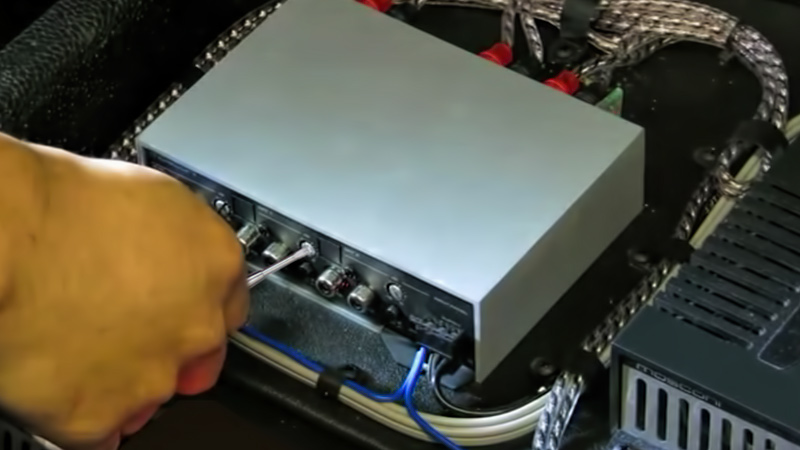
After the measurements are complete, our shop can recommend a solution to help ensure the success of your new system. If you luck out and have a simple factory source unit, you may only need a voltage adapter, commonly called a line output converter, to send an appropriate signal to your amplifier.

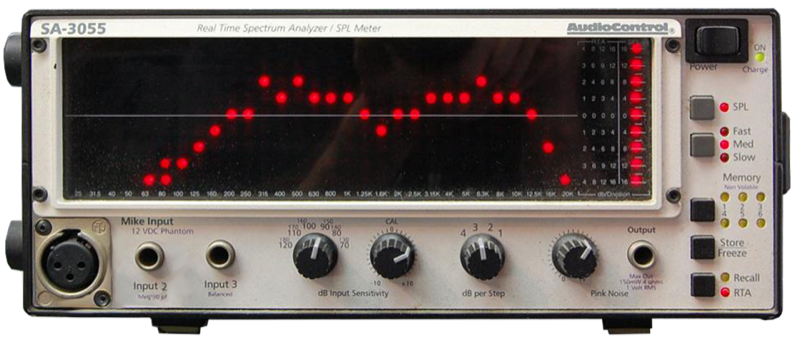
If a large amount of equalization is present from the factory amplifier, then an equalizer or digital signal processor may be adequate to compensate for the factory tuning. A calibrated microphone and audio analysis equipment is required to set up the new system. These devices are expensive, and it takes time to learn how to use them correctly to achieve acceptable results.

OEM Sound System Measurements
The AudioControl DM-810 can be used to tame factory signal problems.

If you have a factory amplifier that includes crossovers or time alignment, then your interface options narrow. Several system integration processors on the market can automatically undo equalization and time alignment, then recombine signals from the subwoofer, midbass, midrange and tweeter outputs. There are also integration modules that will replace your factory amplifier and provide connections that will feed a signal directly to your new amplifier. Unfortunately for the Do-It-Yourselfer, these amplifier replacement modules need to be programmed for the year, make, model and trim level of your vehicle. This configuration process is not something that you can do at home.

Inquiring Minds Want to Know

Performing OEM system measurements are like preparing to have a cavity filled. Before your dentist starts grinding or drilling, he or she will take a series of X-rays so that they know exactly what they are dealing with. The same philosophy applies to constructing a subwoofer enclosure. You’d never see someone start cutting wood without having measured the car accurately.

When it is time to upgrade your factory audio system, visit your local mobile electronics specialist retailer. Ask if they know how your factory audio system is configured in terms of signal processing. If they don’t know, find out whether they have the equipment to measure the factory audio signals in your vehicle. Once you are comfortable with their level of expertise, you can enjoy the process of designing a fantastic sound system for your vehicle. You will be thrilled with the results!

This article is written and produced by the team at www.BestCarAudio.com. Reproduction or use of any kind is prohibited without the express written permission of 1sixty8 media.

Filed Under: RESOURCE LIBRARY, ARTICLES, Car Audio

Definitions: Speaker Parameters

BestCarAudio.com - August 4, 2024

Speaker ParametersThe adage that someone could write a book about a subject certainly holds true when it comes to a discussion of loudspeakers and their parameters. In fact, there are dozens of great books already available about the subject. This article provides an overview of some of the most commonly discussed speaker parameters.

What are Speaker Parameters?

Speaker parameters, often called Thiele/Small parameters, are a set of electromechanical measurements that can be used to define the low-frequency performance of a transducer. Using these parameters and a series of calculations, your installer can predict the performance of that speaker in an enclosure.

What Can We Determine from these Parameters?

Speaker Parameters
T/S Parameters can be used to determine if speakers will work well in small enclosures.

Perhaps the most important set of calculations we can create is the output of the system. When we discuss the “system,” we are referring to the speaker itself and the enclosure in which we intend to install the speaker. Every speaker enclosure acts as a high-pass filter and reduces the low-frequency output of the driver. We gain physical power handling in return for this diminished output. Using a set of calculations, we can predict how much low-frequency information the system will produce.

Another important calculation is power handling. As mentioned, we need to control the movement of the speaker cone to prevent distortion and damage. We can predict how much the cone will move for a given amount of power in our test enclosure.

Resonant Frequency of the Speaker – Fs

In terms of analyzing the moving parts of the speaker, we need to know the frequency at which the compliance (springiness) of the spider and the surround combine with the mass of the cone and dust cap to store the most energy. At this frequency, the system alternately stores and subsequently releases the most energy for a given voltage input. If you were to swing a weight on a string suspended from the ceiling, the natural frequency at which it oscillates back and force would be equal to the resonant frequency of a loudspeaker.

Equivalent Compliance Volume – Vas

To understand how stiff the spider and the surround are, we compare them to an amount of air that would exert the same resistance to motion. Because air is easily compressed, a high Vas specification would represent a very softly suspended cone. Conversely, a speaker with a low Vas would have a very stiff suspension.

Electrical Q of the Driver at Fs – Qes

Speaker ParametersUnderstanding the Q (Quality Factor) can be somewhat difficult because it is a dimension-less value. In essence, the Q factor describes the damping characteristic of a resonant system. A higher Q represents less energy loss relative to the total energy stored in a system. A pendulum suspended from a low-friction bearing will have a high Q. That same pendulum, submerged in water, will have a much lower Q. An important consideration is that high-Q systems have less damping and, therefore, vibrate longer. The Electrical Q specification describes how much damping the voice coil and magnet assembly invoke on the moving cone.

As the voice coil moves past the magnet, it produces an electrical current. This current reaches its peak value at the resonant frequency of the driver and counteracts the current being provided by the amplifier. The net result is a significant rise in impedance at the resonant frequency.

Mechanical Q of the Driver at Fs – Qms

Just as the electrical characteristics of a speaker cause an opposition to cone motion, we have a similar effect from the mechanical properties of the speaker. Qms describes the mechanical losses resulting from the spider and the surround. A high Qms value describes lower mechanical losses, while a low Qms value describes higher losses.

Total System Q at Fs – Qts

This unit-less measurement is a mathematical combination of the mechanical and electrical characteristics of the speaker. In simple terms, we calculate Qts by dividing the total stored energy of the speaker by the dissipated energy in the speaker at resonance.

Compliance of the Driver Suspension – Cms

The Cms specification describes the stiffness of the driver suspension in meters per newton. A stiffer suspension will move less distance for a given amount of force applied to it.

Effective Cone Area of the Driver – Sd

Speaker ParametersThis parameter describes the effective “size” of our speaker. We all realize that the cone will move air for us, but we also have to take into account the addition of the surround. It is commonly accepted that we can use a value of half the surround as contributing to the output of the driver.

Mass of the Cone and Moving Parts – Mms

The Mms specification describes the mass of the speaker cone and part of the spider and surround. Unlike the Mmd specification, Mms includes the acoustic load caused by the air in contact with the cone. In most cases, the values are similar, but as the surface area of the cone increases, so too does the value of Mms, relative to Mmd.

Maximum Excursion Level – Xmax

This parameter is frequently misinterpreted as being the defining factor in the distance a speaker cone can move. Early calculations used a formula that subtracted the height of the voice coil winding from the height of the magnetic gap, then divided by 2. This calculation describes how far the speaker can move before the winding comes out of the gap.

Subsequent investigation shows that non-linear behavior elsewhere in the driver design could have a larger influence on the motion limits of the cone. This suggests that Xmax should be the one-way excursion distance that represents a distortion level of 10%. This performance-oriented specification is far more indicative of the useful operating range of a driver, but is much harder to ascertain.

Additional Parameters

Speaker ParametersIn this article, we only describe the basic parameters that are commonly used in predicting the low-frequency performance of a loudspeaker. Other parameters, such as inductance, become more relevant at higher frequencies. Addition parameters such as Nominal Impedance (Znom), efficiency, sensitivity and the Efficiency Bandwidth Product (EBF) are derived through equations that use the specifications above.

Proper Design Requires Simulation

A woofer in an over-sized enclosure may bottom out and be damaged easily. A midrange driver crammed into a small speaker pod may have a significant frequency response spike and an associated distortion peak. The result is quite unfavorable.

Before you assume a subwoofer or speaker is suitable for the enclosure or mounting location you have chosen, it is worth asking your mobile electronics retailer to perform a simulation to ensure everything will function the way you want. They can work with you to ensure everything will perform optimally, and your system will sound great!

This article is written and produced by the team at www.BestCarAudio.com. Reproduction or use of any kind is prohibited without the express written permission of 1sixty8 media.
Filed Under: RESOURCE LIBRARY, ARTICLES, Car Audio

Product Spotlight: Sony XAV-AX3700 Multimedia Receiver

BestCarAudio.com - May 27, 2024

Sony XAV-AX3700

Car audio source unit manufacturers are constantly developing new products to fill the gaps between entry-level and flagship models. Sony recently released a new 2-DIN digital multimedia receiver called the XAV-AX3700, which slides into the mix just below the XAV-AX4000. This new radio features a 6.95-inch touchscreen display, Apple CarPlay connectivity and iDatalink Maestro vehicle integration. Read on to learn about what else it offers.

Sony XAV-AX3700 Source Features

The XAV-AX3700 starts with extensive support for digital media files stored on a USB flash drive. The radio can decode MP3, WMA, WAV, AAC, FLAC, ALAC, DSF and DSDIFF audio files. It also has Bluetooth, which includes the A2DP and AVRCP profiles, which allow music to stream from a smartphone or digital media player. The radio supports LDAC for impressive wireless sound quality and SBC and AAC for maximum device compatibility.

Of course, the radio has a high-quality AM/FM receiver, which captures RDBS information so you can see album and song title information if the station provides it. The retailer installing the radio can upgrade it with a SiriusXM satellite radio receiver, allowing you to listen to genre-specific music or your choice of entertainment channels nonstop from coast to coast. Sony provides a rich SiriusXM interface, including the channel logo and the album art for the track being played if the station you’re tuned in to provides it.

Sony XAV-AX3700
The XAV-AX3700 can be upgraded with a dedicated SiriusXM satellite radio receiver for uninterrupted entertainment.

Apple CarPlay Smartphone Connectivity

The XAV-AX3700 includes support for wired Apple CarPlay. Plug your phone cable in, and you’ll have access to all the music on your phone or your favorite streaming services. You can choose whatever you want using intuitive voice commands. Of course, you can make phone calls, send text messages or get detailed turn-by-turn directions to any address or business in North America using your favorite app.

Sony XAV-AX3700
Wired Apple CarPlay connectivity makes it easy to communicate while driving.

Vehicle Interface Features

As mentioned, the XAV-AX3700 supports the iDatalink Maestro SR, RR and RR2 interfaces. These modules allow communication with the computers in your vehicle to provide access to climate controls, as well as factory-installed infotainment components like microphones, steering wheel controls and a rear-vision camera.

If your application does not have an RR or RR2 module, your installer can integrate steering wheel controls using other modules, like the Maestro SW. Talk to the Product Specialist you are working with for details about your vehicle’s specific make, model and trim level.

Sony XAV-AX3700
The Sony XAV-AX3700 supports the Maestro SR, RR and RR2 vehicle integration interfaces.

Intuitive Interface Simplifies Operation

Sony is the benchmark when it comes to human-machine interfaces. Not only does the XAV-AX3700 boot incredibly quickly, but the button layout on the screen and the menu functions are super-intuitive. The 6.95-inch touchscreen display is bordered by a row of six buttons along the bottom edge.

The main display menu includes five user-configurable options. You can set your favorite sources or commonly used functions, like the backup camera display, to be readily available. When an iPhone is connected, a dedicated icon for Apple CarPlay appears to the left of the clock.

You can also customize the wallpaper image behind the icons from several included options or upload your own image to personalize the radio. A new customizable clock layout feature gives you an option for either an analog or digital clock in the center of the screen, or a smaller digital clock in the top right corner.

Sony XAV-AX3700 Audio Features

This new Sony radio includes a full suite of audio integration features to maximize the sound system’s performance. A five-channel time alignment screen helps improve staging and imaging. A 14-band graphic equalizer can smooth out peaks and dips in the system frequency response. Built-in electronic crossovers with adjustable slopes maximize the performance of your speakers.

The radio includes a four-channel amplifier rated to produce 20 watts per channel, making driving the factory speakers easy. Thanks to dedicated front, rear and subwoofer preamp outputs, you can easily upgrade the radio with an external amplifier. An integrated subwoofer level control makes fine-tuning your system to suit your music or mood easy.

Sony XAV-AX3700
Time alignment, a 14-band equalizer and adjustable crossovers make it easy to fine-tune your audio system.

Single-DIN Chassis Simplifies Installation

A feature that car audio installers will love is the single-DIN chassis behind the 2-DIN display. This 2-inch tall chassis design leaves room for wiring, integration modules and wire harness adapters. Notably, the space is available beneath the radio, where these parts typically rest. The depth of that chassis is shallow as well, allowing use in vehicles with a tight fit behind the radio screen.

Upgrade Your Driving Experience with Sony

Whether you’re looking to add Apple CarPlay or high-quality audio streaming to an older vehicle, or you have to replace a factory-installed radio that’s kicked the bucket with one that requires the use of a Maestro module that retains some factory features or settings, the new Sony XAV-AX3700 is an excellent choice. Drop by a local Sony car audio retailer today and ask for a demonstration. You can find a retailer using their online locator tool. Also, follow Sony on Facebook and Instagram to keep up with the latest new car audio products.

This article is written and produced by the team at www.BestCarAudio.com. Reproduction or use of any kind is prohibited without the express written permission of 1sixty8 media.
Filed Under: RESOURCE LIBRARY, ARTICLES, Car Audio, PRODUCTS Tagged With: Car Audio, Sony

Hot Rod, RestoMod, and Restoration Source Unit Options

BestCarAudio.com - May 5, 2024

Hot Rod, RestoMod, and Restoration Source Unit OptionsThe stereotypical image of a “Woody” station wagon with a surfboard on the roof is missing one critically important element to make it part of the perfect day on the beach: an audio system. In the 1960s, the aftermarket car audio scene was weak. Compared to now, there weren’t any options for source units, speakers or amplifiers, and certainly nobody had a subwoofer. All of that has changed. Today, aftermarket car audio upgrades can transform your daily driver or project car into something stunning. Let’s think back to our mental image of a ’60s Chevy Woody wagon, but update it with modern speakers, amplifiers and – of course – a new source unit. This article discusses some of the source unit options available to people who are restoring a classic car, building a hot rod or doing anything in between.

Modern Convenience and Performance

Source Unit OptionsIf you are building a street rod or are willing to take some liberties with the look of your dash, then cutting an opening for a single-DIN radio or making a console for a double-DIN radio provides you with an excellent opportunity to have all the latest features and technologies right at your fingertips.

Bluetooth hands-free calling is essential to your safety when on the road. Audio streaming will let you play music from your smartphone or a streaming service wirelessly to your radio. Digital media file playback provides you with a way to access your modern MP3 music collections. Finally, navigation systems can help get you where you want to go quickly and safely.

Many modern radios have the ability to change the color of the controls and the display. You can match the color of your radio to a set of incandescent bulbs in the gauges of a ’30s roadster or the blue glow of a set of new digital gauges. Some people set the radio to match the color of the car.

Contemporary Performance and Classic Style

Several manufacturers produce modern radios with traditional twin-shaft mounting systems. These radios include features like USB ports for your digital media collection or your Apple iPod or iPhone. Bluetooth audio streaming and hands-free calling functions are standard on many models, and SiriusXM satellite radio connectivity will let you enjoy genre-specific programming from coast to coast.

These radios feature vintage styling with simple LCD and LED displays where the old analog tuner used to be. Multi-function knobs on either side of the primary display handle controls for volume, tuning and source selection functions. These radios include between 18 and 25 watts of power from the built-in amplifier and have pre-amp outputs for adding external amplifiers.

Connectivity with the latest devices may not be as up to date as with a modern aftermarket radio, but these vintage radios can conceal themselves well in your dash.

The Hidden Radio Solution

Source Unit OptionsIf you are working hard to keep the interior of your vehicle looking original, then your best bet is not to show off a new radio at all. Some people will mount an aftermarket radio in the glove box or under the front seat. These radios are still accessible while you’re driving, but not as easily.

For several years, the hot ticket was to install a marine radio in the trunk or a storage compartment. The driver would have access to a wired remote control to change the volume or source. These marine remotes often include small displays to let you know what station or track you are enjoying.

Modern marine source unit remote solutions include IR and RF remotes, as well as iPod or iPhone remotes that use WiFi for communication. You can use your radio quite easily without being able to see it at all.

Custom Remote Control Solutions

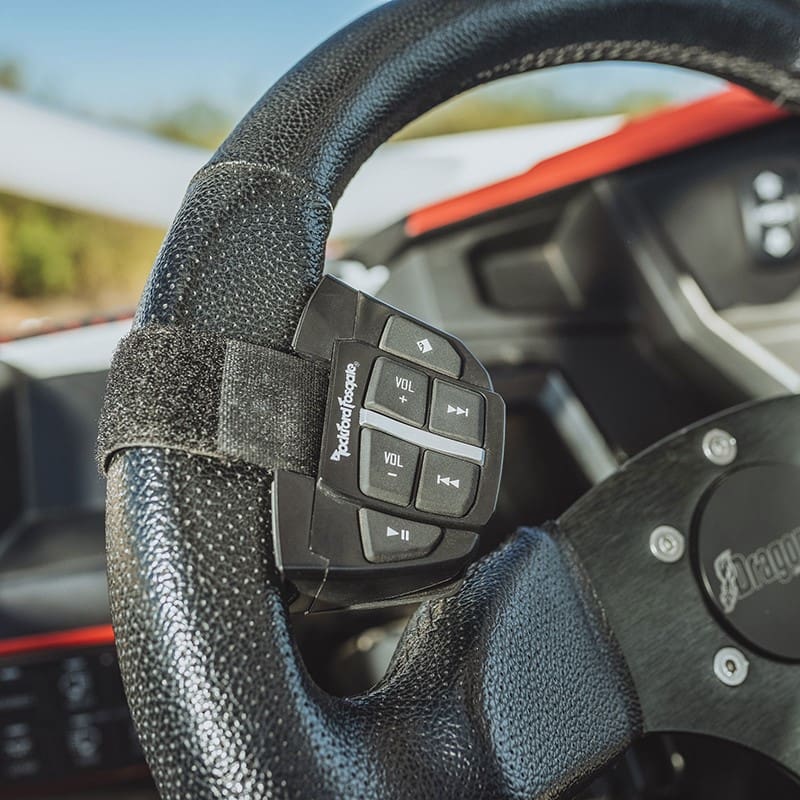
One “trick” that people often forget about is to use an OEM steering wheel audio control interface with a set of custom switches to control the radio. Your installer can program a set of switches with unique resistor values to perform almost any function you want. A spare four-way power window rocker switch makes a great volume and track selection control. You could use power window and power lock switches on a door to perform similar functions. The options for custom remote controls are nearly endless.

“Radio? We Don’t Need No Stinkin’ Radio!”

Source Unit OptionsThe modern smartphone has started to replace radios altogether in some projects. Being able to stream radio stations over the Internet or use services like Pandora or iHeartRadio makes your cellphone and its wireless Bluetooth connection the only source you may need.

In the most basic of applications, your installer can connect a stand-alone Bluetooth receiver to a small amplifier and new speakers. The volume control on your smartphone will serve as the master volume control for the sound system. The system will power up as soon you connect to the Bluetooth module and start streaming audio.

If you are after a better-sounding system, then you may want to look at a signal processor with an optional Bluetooth streaming module. Several digital signal processors (DSPs) on the market can stream high-quality audio directly without the need for a source unit. The audio processing functions of the DSP will allow your installer to maximize the performance of each speaker in your system and create an amazing sonic experience.

Shop Local for Your Source Unit Options

Before you get too deep into your restoration or project build, contact your local mobile enhancement retailer today to discuss suitable source unit options for your vehicle. They will be able to explain the benefits of each system and provide you with all the information the restoration shop you are working with will need to bring the concept to fruition. No matter what source unit option you choose, having great speakers and amplifiers in your classic car or hot rod will make going for a cruise much more enjoyable.

This article is written and produced by the team at www.BestCarAudio.com. Reproduction or use of any kind is prohibited without the express written permission of 1sixty8 media.

Filed Under: RESOURCE LIBRARY, ARTICLES, Car Audio, Classic Car Audio

  • « Go to Previous Page
  • Page 1
  • Interim pages omitted …
  • Page 4
  • Page 5
  • Page 6
  • Page 7
  • Page 8
  • Interim pages omitted …
  • Page 23
  • Go to Next Page »

Primary Sidebar

About Us

About Us

Devine Concepts is a mobile electronics retailer based in Naples, Florida. We are led by Adam Devine, a 20-year veteran in the industry and a Mobile Electronics Association top 50 … [Read More...]

Take a Tour of Our Facility

virtual tour

We invite you to tour our facility virtually. We hope you love what you see. (It’s even better in person!)

Car Audio

Car Audio

Devine Concepts in Naples, Florida, specializes in car audio. While some shops offer this as one of their services, it is the main focus in our facility. In fact, our owner Adam … [Read More...]

Radar / Laser Detectors

Radar / Laser Detectors

One of the specialties at Devine Concepts in Naples, Florida, is laser and radar detectors. We offer both portable and custom-installed solutions to our clients. It is our opinion … [Read More...]

Custom Installation

Custom Installation

Custom Installation

Devine Concepts in Naples, Florida, was founded in 2018 by Adam Devine, an MECP Master Installer with more than 20 years of experience,  and one of the most-awarded mobile … [Read More...]

Footer

Location


Get Directions to Devine Concepts

Address

Devine Concepts

14848 Old 41 Rd Suite 9
Naples, FL 34110
(239) 451-3210

Services

  • Car Audio
  • Custom Installation
  • Driver Safety
  • Radar / Laser Detectors

Connect with Us

  • Facebook
  • Instagram
  • YouTube

Store Hours

Monday, Tuesday, Wednesday, Thursday, Friday9:00 am – 5:00 pm

Copyright © 2026 Devine Concepts · Privacy Policy · Website by 1sixty8 media, inc. · Log in